Alien and Philosophy by Irwin William; Decker Kevin S.; Ewing Jeffrey A. & Kevin S. Decker
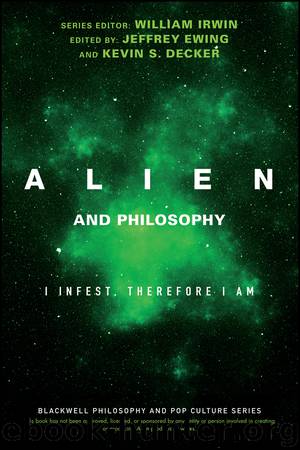
Author:Irwin, William; Decker, Kevin S.; Ewing, Jeffrey A. & Kevin S. Decker
Language: eng
Format: epub
Publisher: John Wiley & Sons, Incorporated
Published: 2017-07-24T00:00:00+00:00
Alienation
One of our earliest encounters with the crew of the Nostromo centers on a dispute about wages. Brett and Parker lobby their shipmates for full shares of the anticipated bonus, but Dallas and Ash contend that there is nothing to discuss. Instead of siding with the engineers, who are indispensible to the success of the mission, Dallas promotes the interests of the Company, despite its disregard for him. The irony here is that the very contract he cites as the basis for a “fair” distribution of bonus shares also obliges the crew to respond to any potential distress signal the ship might receive. Dallas is thus exposed as serving, simultaneously, as a spineless shill for the Company and as a disposable asset in its covert bioweapons research program.
We shouldn’t be surprised by any of this, Karl Marx would claim. So long as the capitalist mode of production remains viable and authoritative, Marx insists, workers will suffer the indignities associated with alienated labor. According to him, the true aim of labor isn’t limited to the immediate satisfaction of the basic needs of particular human beings. In a passage that speaks both to the supposed “purity” of the Xenomorph and to the potentially burdensome complexity of human beings, Marx explains, “[A]n animal only produces what it immediately needs for itself or its young. It produces one‐sidedly, whilst man produces universally…even when he is free from physical need and only truly produces in freedom therefrom.”5 To be fully human, Marx believes, is to be involved with others in the free, creative transformation of the natural world and, then, to see oneself reflected in the fruits of one’s labor. This positive reflection activates a self‐sustaining feedback loop, inspiring all workers to continue to improve themselves and the fruits of their labor.6 According to Marx, that is, labor is the activity through which human beings may attain self‐knowledge, which includes the recognition of themselves as representative members of humanity as a whole.7
Let’s begin by considering the first of these forms: alienation from the product(s) of one’s labor. As Marx explains,
[T]he object which labor produces—labor’s product—confronts it as something alien, as a power independent of the producer…Labor’s realization is its objectification. In the conditions dealt with by political economy this realization of labor appears as loss of reality for the workers; objectification as loss of the object and object‐bondage; appropriation as estrangement, as alienation.8
Download
This site does not store any files on its server. We only index and link to content provided by other sites. Please contact the content providers to delete copyright contents if any and email us, we'll remove relevant links or contents immediately.
Still Foolin’ ’Em by Billy Crystal(36468)
Spell It Out by David Crystal(36236)
The Great Music City by Andrea Baker(33609)
Professional Troublemaker by Luvvie Ajayi Jones(29759)
Trainspotting by Irvine Welsh(21971)
Call Me by Your Name by André Aciman(20713)
The Secret History by Donna Tartt(19467)
We're Going to Need More Wine by Gabrielle Union(19168)
Cat's cradle by Kurt Vonnegut(15555)
Ready Player One by Cline Ernest(15139)
Molly's Game by Molly Bloom(14258)
Bombshells: Glamour Girls of a Lifetime by Sullivan Steve(14217)
The Goal (Off-Campus #4) by Elle Kennedy(13963)
Leonardo da Vinci by Walter Isaacson(13507)
4 3 2 1: A Novel by Paul Auster(12611)
The Social Justice Warrior Handbook by Lisa De Pasquale(12293)
The Break by Marian Keyes(9493)
Crazy Rich Asians by Kevin Kwan(9418)
The remains of the day by Kazuo Ishiguro(9219)
